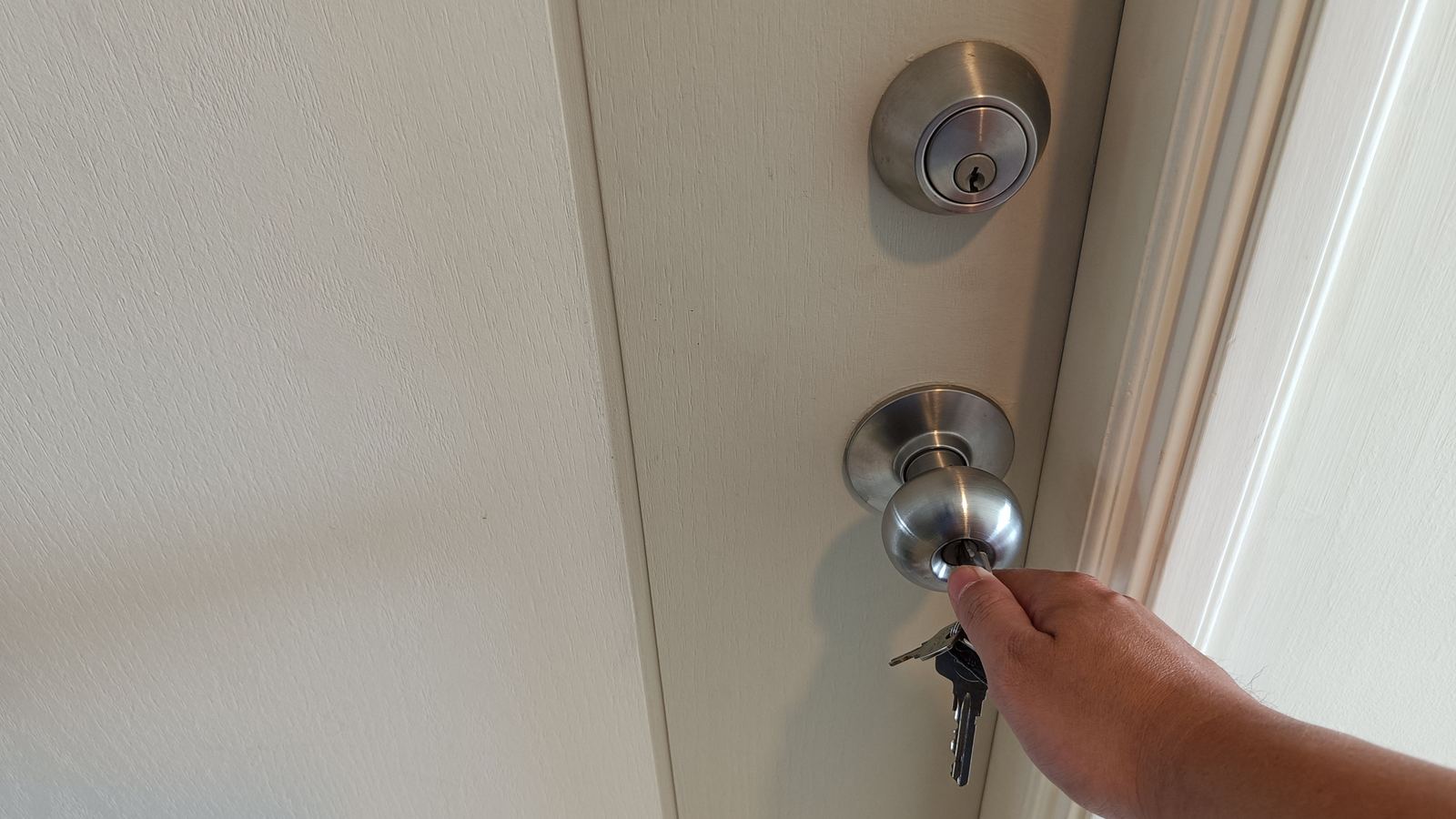
Between your call and the knock, three things are happening: dispatch assigns a technician, the tech drives with whatever information you gave, and you have a window to prepare. Use it — text a photo of the lock, have photo ID ready to prove you belong there, confirm the exact address including unit and gate codes, and keep the written quote handy. On arrival, expect a marked vehicle, ID, and confirmation of the written total before any work starts.
Try these free routes first
Text a photo of the lock and door right now
One clear photo of the lock face, and a second of the whole door, tells the technician more than most phone descriptions: brand, deadbolt versus knob, keypad versus keyway, apparent condition. That lets them bring the right approach and parts, avoid a second trip, and — importantly for you — commit to a firmer price, since surprises at the door are where quotes drift. Send it to the number you called, with your address in the same message so nothing gets crossed in dispatch.
Stage your ID and proof you belong there
A legitimate locksmith will ask for evidence you have the right to enter this home — photo ID with the address, a lease or a bill on your phone, or a neighbor who can vouch. Having it ready before the knock keeps the visit short and marks you as a customer who knows how this is supposed to work. If your ID shows an old address, pull up something current in email now, while you have nothing but time. A pro asking for ID is a good sign, never an insult.
Confirm the exact address and access details
Wrong-address delays are among the most common reasons a short wait becomes a long one. Text the full address including unit number, building name, gate or callbox code, which entrance to use, and where you will physically be standing. If you are in a complex, offer to meet at the gate. If it is dark, turn on the porch light or describe a landmark. Every minute the driver spends circling is a minute added to your wait, and it costs nothing to remove all of it in one message.
Re-read your written quote and set your line
Pull up the total you were quoted in writing and fix the number in your mind, along with your decision rule: the arriving tech confirms this total before work begins, and a materially different number means you decline. Deciding this now, calm and warm, is far easier than deciding it at the door under pressure — the doorstep escalation script specifically targets people who have not pre-committed. If you never got the quote in writing, call back now and ask for it by text; a legitimate shop will send it without friction.
What actually happens between my call and the arrival?
At a real local shop, your call reaches someone who can talk about the job: they ask what kind of lock, quote a written range, and either come themselves or dispatch a technician whose drive time sets your wait — quoted arrival windows stretch with traffic, night hours, and weather, so a range is normal and honest. At a national dispatch operation, your call reaches a call center that sells the job to whichever affiliated contractor is nearby, which is why the person who arrives may know nothing about what you were quoted — a structural gap the bait-price model exploits. This difference is worth knowing while you wait: if the arriving technician seems unaware of your quote, that is a signal about what you called, not a misunderstanding to smooth over. A shop that dispatches its own people usually texts the technician's name, and you can ask for it. Use a long wait productively: re-verify the shop's address on a map and keep trying free options — a reachable roommate beats any arrival time.
What information should I send to speed things up?
Five items, all sendable by text in two minutes. First, photos: the lock face close up and the full door, which identify brand, type, and condition better than any description. Second, the exact address with unit number, gate codes, entrance, and where you are standing — wrong-address circling is the most preventable delay there is. Third, the situation in one line: locked out, key broke off, key turns but door will not open, smart lock dead — each is a different job with different tools. Fourth, your callback number and confirmation you will have ID proving residency, which removes the arrival's slowest step. Fifth, constraints worth knowing: a child or pet inside, a door that must not be damaged because it is a rental, an after-hours building that needs an escort. Everything on this list either shortens the visit or firms up the price, and both work in your favor.
What does a legitimate arrival look like?
It looks accountable at every step. The vehicle is marked with the business name you called — or the technician immediately offers identification connecting them to it. The person gives a name, shows photo ID or, in the dozen or so licensing states, the license they are required to carry, and asks for your ID or other proof you have the right to enter this home; that mutual verification is recommended in the Federal Trade Commission's consumer guidance and is the professional norm. Before any tool comes out, the tech looks at the lock, explains the approach, and confirms the total — matching the written quote — with any change explained and re-agreed in writing first. On a lockout, expect non-destructive methods first; professionals treat drilling as a last resort for genuinely failed or fortified hardware, and a real pro who does need to drill will show you why before asking permission. Afterward comes an itemized invoice with the business name and address. That is the whole picture; deviations are information.
What are the red flags while I wait and at the door?
During the wait: a callback from a different business name than the one you dialed; refusal to send the quote by text after promising it; an arrival window that keeps resetting without explanation; or a call pressuring you to agree in advance to whatever the technician finds. At the door: an unmarked personal car with no offered identification; no interest in whether you live there; a price that has grown before any work or any discovered complication; the announcement, within moments and before any attempt, that the lock is special and must be drilled — professionals drill as a last resort, so an instant drill verdict is the classic escalation tell; and cash-only or payment-app-only demands, which exist to defeat card disputes. Each flag alone justifies pausing; two or more justify declining outright. Remember the timing of your leverage: it is total before work begins and nearly gone after, so the doorstep confirmation of the written total is the moment that matters most.
Can I cancel while they're on the way?
Yes. If a roommate turns up with a key, the super answers, or you simply change your mind, call the shop and cancel — the earlier the better, as a courtesy and practically. Whether you owe anything depends entirely on what was disclosed when you booked: a legitimate shop that told you about a service-call or dispatch fee up front may fairly charge that disclosed amount if the truck is already rolling, and paying a disclosed fee you agreed to is the clean outcome. A cancellation penalty invented after the fact, or a demand for the full job price for a visit that never happened, has no basis — decline it and document the demand. This is one more reason the written pre-dispatch quote matters: it fixes not just the job price but what showing up costs. If you reached a call-center dispatcher rather than a shop, cancel with extra clarity — say the words do not send anyone, note the time, and keep the call log.
How do I wait safely and comfortably?
Treat the wait as a small logistics problem. Position yourself somewhere lit and populated — your porch light on, a neighbor's stoop, the building lobby, your car if you have keys to it; avoid standing in a dark doorway with your attention buried in your phone. Cold or heat matter over a long window, so a neighbor's apartment or a nearby open business beats toughing it out. Keep your phone charged for the arrival call — if the battery is low, a neighbor's charger is a fair ask. If a child or pet is inside alone, say so when you call, because that legitimately raises urgency, and reassess whether a household member with a key can beat the technician's arrival after all. When the vehicle pulls up, stay where you are and let them come to you; a legitimate technician expects to introduce themselves, show ID, and check yours before approaching the lock. The wait is the boring part — keep it that way.
When calling a locksmith is the right move
This page assumes you already called — so the question is when to call again. Call back if the arrival window passes without contact, if you need to add information like a gate code, or to cancel because a key arrived; get any changes in a follow-up text. Call a different shop if red flags stack up during the wait: a different business name on the callback, a quote that will not be put in writing, a window that keeps sliding. And call the police non-emergency line rather than any locksmith if what you actually have is a changed-locks dispute, a hostile co-tenant, or someone refusing to leave your property.
📞 Call (866) 370-8695
Quick answers
How long should a locksmith take to arrive?
A local shop typically quotes a window measured in fractions of an hour to an hour or so, stretching at night, in bad weather, or far from town — an honest range beats a suspiciously precise promise. What matters is communication: a real dispatcher can name the technician and update you. A window that keeps resetting without explanation is a flag worth acting on.
Why does the locksmith want a photo of my lock?
Because the photo determines the job: brand, deadbolt versus knob, keypad versus keyway, and visible condition tell the tech what tools and parts to bring and let the shop commit to a firmer price. It protects you, too — a quote given against a photo has far less room to drift at the door. Send the lock face and the whole door.
Will they really ask for my ID? What if my ID shows an old address?
A legitimate locksmith verifies you have the right to enter — FTC guidance endorses exactly this. An old address on your license is common; supplement it with a lease, a utility bill in your email, mail inside the door they can see once open, or a neighbor vouching. Sort your proof out during the wait, not at the knock.
The person who arrived doesn't know what I was quoted. Is that normal?
At a real shop, no — the dispatcher and technician are the same operation. A tech disconnected from your quote usually means you reached a call-center dispatch network that sold your job to a contractor, which is the structure behind on-arrival price escalations. Show the written quote; if the tech will not honor it before starting, decline and rebook elsewhere.
Should I agree to work starting before the price is confirmed?
No. The total — matching your written quote, or a re-explained and re-agreed revision — comes before any tool touches the lock. This is the single moment of maximum leverage in the whole encounter, and both the FTC's guidance and every legitimate shop's own practice put the price conversation there. A pro will volunteer it; you should never have to chase it.
Related guides and services